Skip to content

1925 · Baden-Baden

Alekhine’s rook

Richard Réti vs Alexander Alekhine

Alekhine plants his rook on e3, deep in White’s camp, then launches a combination that unfolds over some fifteen moves, until he wins material.

The key move

Alexander Alekhine plays 36…Rxf3

The rook takes on f3: the black pieces get back more than they gave.

26…Re352/80

Key momentThe rook settles on e3, in the heart of White’s camp: the move that made the game famous.

Key moments

Click a moment to set the board on that move.

Moves of the game

  1. 1.
  2. 2.
  3. 3.
  4. 4.
  5. 5.
  6. 6.
  7. 7.
  8. 8.
  9. 9.
  10. 10.
  11. 11.
  12. 12.
  13. 13.
  14. 14.
  15. 15.
  16. 16.
  17. 17.
  18. 18.
  19. 19.
  20. 20.
  21. 21.
  22. 22.
  23. 23.
  24. 24.
  25. 25.
  26. 26.
  27. 27.
  28. 28.
  29. 29.
  30. 30.
  31. 31.
  32. 32.
  33. 33.
  34. 34.
  35. 35.
  36. 36.
  37. 37.
  38. 38.
  39. 39.
  40. 40.

The context

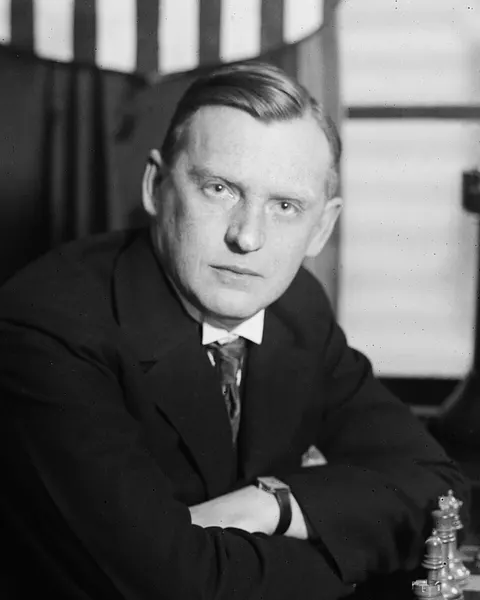
April 1925, in Germany. Alexander Alekhine, who left Russia and settled in France, dominates the tournaments of the time; two years later he will become world champion. Richard Réti, a Czechoslovak master, is one of the fathers of the hypermodern school, which prefers to control the center from afar rather than occupy it.

The game

Réti opens with 1.g3 and fianchettoes his bishop. Alekhine takes the initiative in the center, then goes after weaknesses on the queenside. On move 26 he plants his rook on e3, in the heart of White’s camp: the move that made the game famous.

The finish

After the queens come off, the black pieces invade White’s camp: knights to e2 then f2, repeated checks, a rook that takes on f3. On move 40, …Nd4 wins material and Réti resigns. Some databases add two more moves, 41.Rf2 Nxf3+ 42.Rxf3 Bd5; our two sources agree up to 40…Nd4.

The story behind it

Alekhine won the Baden-Baden tournament. His opponent that day gave his name to an opening, the Réti, with 1.Nf3 then c4.
The lesson for your games

Pieces given away

A single missed combination was enough. Zeitnot counts your blunders per 100 moves, compares them with players at your level, and explains the worst ones, with the move you should have played.

The full guide in the Library →
See if you do it

Free preview in 20 seconds, no sign-up

Do you apply this lesson in your games?

Type your username: the free preview reads your recent games and opens on your grade for this theme, with your biggest leak. No account.

Free, no account, no card. We never log into your account.

The players

In the same hall · The age of the masters