The context
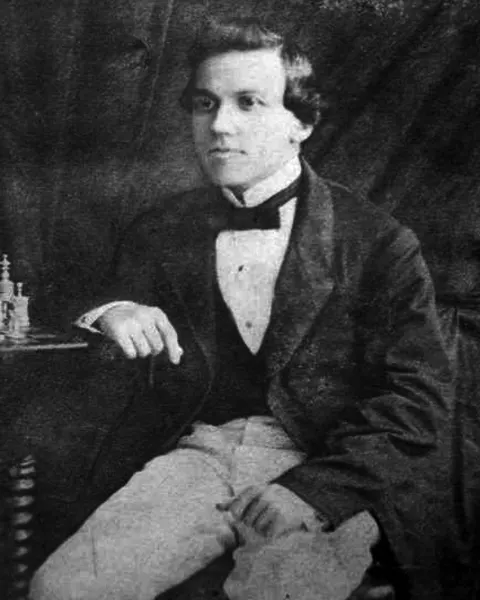
Autumn 1858. Paul Morphy, 21, from New Orleans, is touring the clubs of Europe and beating every master he meets. Duke Karl II of Brunswick, a keen chess lover, invites him to his box at the Théâtre-Italien, in the Salle Ventadour. There Morphy plays the Duke and Count Isouard, who decide every black move together.
The game
Black plays 3…Bg4, a hasty developing move: the bishop has to be traded for the knight on f3, and the white queen recaptures while gaining time. Morphy then brings out every piece with a threat. On move 10, he sacrifices a knight to open lines toward the black king, which has not castled.
The finish
Morphy castles queenside, his rook comes in on d7 and is given up, then 16.Qb8+ offers the queen: the black knight has to take it, and 17.Rd8 is mate. The rook, protected by the bishop on g5, strikes a king boxed in by its own pieces.
The story behind it
Frederick Milnes Edge, who travelled with Morphy in Europe as his secretary, wrote that the Duke played chess in his box throughout the performances. The game is still used to teach three ideas at once: develop quickly, open the position when the opponent has not castled, and give up material to gain time.